
Entrepreneur vs intrapreneur: What makes these two approaches to business different? Starting an independent business involves financial risk, important decisions, and building something from the ground up. However, many entrepreneurial skills can also be developed within an established business model, without taking on the same startup risks.
Intrapreneurship offers another approach. By working within an established business model, individuals can develop sales, leadership, and business-building skills while benefiting from proven systems, resources, and mentorship.
Although entrepreneurs and intrapreneurs operate in different environments, they share an important characteristic: both look beyond individual tasks to understand how their decisions contribute to larger business outcomes.
Understanding the difference between entrepreneurship and intrapreneurship can help you recognize opportunities to take ownership of your professional growth and gain business experience without immediately assuming the full risks of starting an independent company.
In this blog, we will explore:
- Entrepreneur vs. Intrapreneur: What Are the Main Differences?
- The Business Skills Entrepreneurs and Intrapreneurs Have in Common
- Why Mentorship Matters in Intrapreneurship
- Building an Entrepreneurial Mindset, Regardless of Your Role
- Choosing a Path That Supports Your Professional Growth
- Frequently Asked Questions About Entrepreneurship and Intrapreneurship
- Continue the Conversation
Entrepreneur vs. Intrapreneur: What Are the Main Differences?
An entrepreneur is someone who starts or operates an independent business, taking on the financial and operational risks that come with ownership.
Beyond developing a product or service, entrepreneurs establish the systems needed to run their business. This includes generating revenue, managing expenses, recruiting employees, and making decisions that support long-term growth.
An intrapreneur, on the other hand, applies entrepreneurial thinking within an established business. Rather than building every system independently, they can benefit from existing resources, experienced leaders, and a business model with a proven track record.
At The Acquisition Group, this approach can be seen through independent contractors who develop their own sales performance and leadership skills while working within an established organization.
Consider a contractor representing an established brand. They can take ownership of how they build customer relationships, develop their sales approach, and pursue performance goals while benefiting from existing training, brand recognition, and operational support. They have opportunities to exercise autonomy and build their own results without having to establish an entirely new business infrastructure.
The main differences include:
| AREA | ENTREPRENEUR | INTRAPRENEUR |
|---|---|---|
| Business ownership | Establishes or owns an independent business | Builds within an established business model |
| Financial risk | Assumes the financial risks of starting and operating a business | Can reduce startup risk by using established systems, while still facing performance-related uncertainty |
| Resources | Must develop or obtain business systems, resources, and support | Benefits from existing infrastructure, mentorship, and proven processes |
| Decision-making | Has significant control over business direction, subject to legal, financial, and other obligations | Exercises autonomy in how they approach customer interactions, develop their sales strategies, and pursue their goals within established business standards |
| Primary focus | Building and sustaining an independent business | Building their own results, earning potential, and professional expertise while representing an established brand |
| Professional development | Learns through the demands of business ownership | Develops entrepreneurial skills through hands-on experience, mentorship, and a proven business model |
The distinction comes down to the risks individuals assume and the resources available to help them succeed.
Entrepreneurs have the independence to build their own systems, while intrapreneurs can follow an established path and learn from the experience of those who have already navigated similar challenges.
Understanding entrepreneur vs intrapreneur career paths can help individuals choose how they want to build business experience, whether independently or through a proven business model.
Business Skills Entrepreneurs and Intrapreneurs Have in Common
Whether someone is building a business from scratch or developing within an established organization, many of the same skills contribute to their success.
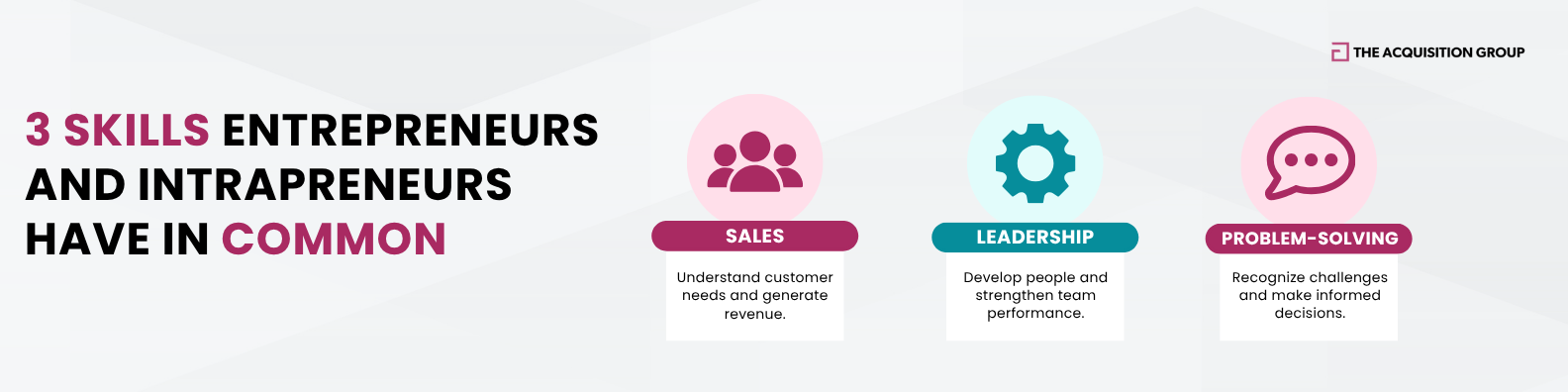
Three important areas are sales, leadership, and problem-solving.
1. Sales: Understanding How Revenue Is Generated
Sales is fundamental to business growth. Understanding how to identify customer needs, communicate value, and build relationships helps individuals recognize how revenue is generated.
For an entrepreneur, these skills support customer acquisition and business profitability. For an intrapreneur working in a commission-based sales environment, improving sales performance can also create opportunities to increase personal earnings.
Consider a contractor who becomes more effective at understanding customer needs and communicating solutions. Stronger sales skills can improve their performance while helping them build confidence, strengthen customer relationships, and pursue their financial goals.
Although earnings are never guaranteed, developing sales expertise gives individuals a skill they can continue applying throughout their careers.
2. Leadership: Understanding How to Develop People
As a business grows, leadership becomes increasingly important. Developing others requires strong communication, constructive feedback, and the ability to empower people to work toward their goals.
Imagine two team members who are struggling to meet the same performance expectations.
One may understand the process but lack confidence applying it independently. The other may be confident but consistently overlook an important step.
Treating both situations identically may produce limited improvement because the underlying challenges are different. A leader needs to understand what is preventing progress before deciding how to respond.
This is why learning to navigate difficult conversations at work is an important part of leadership development. Providing feedback, addressing performance concerns, and communicating expectations require leaders to consider not only what needs to change, but how to approach the conversation in a way that supports understanding and accountability.
A leader who can recognize the issue but struggles to communicate it may find that the same problems continue. Developing stronger communication skills allows leaders to turn their observations into conversations that help people understand expectations and improve their performance.
An entrepreneur cannot necessarily continue managing every responsibility personally as the company expands. Similarly, an intrapreneur who takes on leadership responsibilities must learn how to support team performance rather than relying exclusively on their own abilities.
In both cases, learning to develop people prepares individuals for a stage of business growth where results depend not only on what they can accomplish themselves, but on what they can help a team accomplish together.
3. Problem-Solving: Looking Beyond the Immediate Issue
Running a business requires the ability to recognize challenges, evaluate options, and find practical solutions.
Entrepreneurs often need to develop solutions independently, particularly when establishing unfamiliar processes or navigating unexpected challenges.
Intrapreneurs can approach similar situations while drawing on established systems and the expertise of experienced leaders.
For example, a contractor encountering a recurring sales challenge can evaluate their approach, seek guidance, and apply proven techniques rather than having to develop every solution from scratch.
This combination of independent thinking and access to experience allows individuals to strengthen their problem-solving skills while developing the judgment needed to make more informed business decisions.
Why Mentorship Matters in Intrapreneurship
One advantage of intrapreneurship is the opportunity to learn from experienced professionals while developing business skills through an established model.
Mentorship provides access to practical knowledge, proven approaches, and guidance that can help individuals recognize opportunities and avoid common mistakes.
The importance of this support is reflected in research on intrapreneurship. A 2023 study published in European Research on Management and Business Economics examined the relationship between leadership styles, organizational support, and intrapreneurial behaviour.
Researchers found that leadership was associated with intrapreneurial behaviour through organizational support, highlighting the importance of resources and guidance in helping individuals pursue new ideas.
Although the research examined organizational settings more broadly, it reinforces an important principle: entrepreneurial initiative can benefit from an environment that provides the tools and support needed to put ideas into practice.
Jyah, Marketing Manager at The Acquisition Group, experienced this progression firsthand. Starting without a background in sales or marketing, he developed his skills through training and mentorship before moving into positions involving interviews, workshops, coaching, and team leadership.
His experience illustrates how access to experienced leaders and established systems can help individuals develop skills they may otherwise need to learn independently.
However, mentorship is most valuable when combined with personal initiative. Individuals must still be willing to ask questions, apply feedback, and take ownership of their development.
For contractors interested in building their own business experience, this combination offers a meaningful advantage. They can develop entrepreneurial skills, learn from established practices, and pursue their own professional goals while reducing some of the risks involved in starting from scratch.
Building an Entrepreneurial Mindset, Regardless of Your Role
Developing an entrepreneurial mindset begins with becoming more intentional about how you approach your work, the opportunities you pursue, and the skills you choose to develop.
Before your next opportunity, consider:
Am I developing skills that create value for my future?
Look beyond your immediate results and consider how the skills you’re developing can support your personal and professional goals. Whether it’s strengthening customer relationships, improving sales performance, or gaining leadership experience, these abilities can increase your value as a professional and create opportunities for greater independence and earning potential.
Am I solving problems or only responding to them?
When an issue continues to occur, consider whether there is an underlying process or challenge that needs attention. Recognizing the cause of a recurring problem can help you develop solutions that benefit more than the immediate situation. For an intrapreneur, developing this judgment can also build the confidence to navigate challenges independently and make more informed business decisions.
What skills do I need to develop to pursue my career goals?
Consider where you want your career to take you and what knowledge or abilities will help you get there. Whether your goal is to become a stronger sales professional, develop as a leader, or eventually establish your own business, identifying these skills early allows you to pursue experiences that support your ambitions.
Am I learning from the people around me?
Experienced team members and leaders can offer perspectives that help you understand situations differently. Asking questions about how they approach decisions, manage challenges, and develop others can expand your understanding of business operations and provide valuable insight into building your own path to success.
Am I becoming more capable, or simply more familiar with my responsibilities?
Experience matters, but progress also requires a willingness to challenge existing habits, embrace unfamiliar situations, and take calculated risks. Whether that means trying a different sales approach, pursuing a leadership opportunity, or making a decision independently, stepping outside your comfort zone can help build confidence and develop new capabilities.
These questions help turn entrepreneurial thinking into something practical.
Rather than viewing entrepreneurship as an ambition that begins only when someone launches a company, individuals can begin developing relevant skills through the decisions and opportunities they pursue in their everyday work.
The same applies to intrapreneurship. Taking initiative becomes more meaningful when it is connected to your personal ambitions, professional development, and the opportunities available through an established business model.
Over time, these habits can help individuals become more capable of recognizing opportunities, building their own success, and pursuing new avenues for personal and professional growth.

Choosing a Path That Supports Your Professional Growth
The difference between entrepreneurship and intrapreneurship ultimately comes down to the environment in which entrepreneurial thinking is applied.
Entrepreneurs build and operate independent businesses, assuming the responsibilities and risks that come with ownership. Intrapreneurs apply similar skills and initiative while benefiting from established business systems, proven processes, and experienced leaders who can support their personal and professional development.
Both approaches require an understanding of how businesses operate, how people contribute to results, and how decisions create value. However, gaining that experience does not necessarily require taking on the significant financial risks associated with starting an independent business.
It can begin by learning how an established business generates revenue, building customer relationships, seeking mentorship, and developing skills that support your individual goals.
For someone planning to start a company, developing entrepreneurial skills through an established organization can provide an opportunity to understand the challenges of business management before assuming the financial risks and obligations of independent ownership.
For someone interested in growing through an established business model, intrapreneurship can provide opportunities to strengthen leadership skills, develop greater independence, and build their own earning potential and professional confidence. Rather than creating every system from scratch, they can learn from established practices while pursuing their personal ambitions.
Neither path guarantees success, and neither removes the need for continued learning. What they share is the importance of developing skills that allow individuals to recognize opportunities and respond effectively to new challenges.
Before deciding whether entrepreneurship or intrapreneurship is the right path, it may be more useful to consider what you want to become capable of doing.
The advantage of intrapreneurship is the opportunity to take ownership of your growth while learning from an established business model. You can develop entrepreneurial skills, gain practical experience, and pursue your goals without necessarily assuming the full startup risks of independent business ownership.
You do not need to own a business to begin developing entrepreneurial skills. By learning from proven systems, building your expertise, and taking initiative, you can create opportunities for personal and professional growth while developing the experience to pursue the career path you choose.
Frequently Asked Questions About Entrepreneurship and Intrapreneurship
What is the biggest difference between an entrepreneur and an intrapreneur?
An entrepreneur establishes and operates an independent business, assuming the risks associated with ownership. An intrapreneur applies entrepreneurial thinking within an established business, benefiting from existing systems, resources, and experience. Both can develop business expertise, but intrapreneurship can offer a more established path with reduced startup risk.
What is an example of intrapreneurship in the workplace?
A contractor who takes initiative to improve their sales approach, develops stronger customer relationships, and shares successful strategies with other team members is demonstrating intrapreneurial thinking. By applying proven business practices while developing their own expertise, they can strengthen their performance, build confidence, and create opportunities for personal growth and increased earning potential. Their initiative can also help empower others to develop their skills and pursue their own goals.
What skills are important for entrepreneurs and intrapreneurs?
Sales, communication, leadership, problem-solving, and decision-making are critical skills for both entrepreneurs and intrapreneurs. These abilities help individuals build customer relationships, overcome challenges, develop others, and make informed business decisions. For intrapreneurs, strengthening these skills can also improve their current performance, increase confidence, and create opportunities to grow their earning potential and professional expertise while benefiting from an established business model.
Can someone become an entrepreneur after working as an intrapreneur?
Yes. Intrapreneurship can provide valuable experience for someone interested in eventually becoming a business founder. By learning from established systems, proven processes, and experienced leaders, individuals can develop sales, leadership, and business-building skills without initially assuming the full financial risks of starting a company. While independent ownership comes with additional challenges, intrapreneurship can help individuals build the confidence and practical knowledge to pursue that path, should they choose to.
Continue the Conversation
Understanding entrepreneur vs intrapreneur opportunities can help you identify a path that supports your goals, professional development, and willingness to take on financial risk.
Watch the full video on The Acquisition Group’s YouTube channel, where Jyah shares his perspective on developing entrepreneurial skills within an established organization, the importance of mentorship, and the lessons he has learned through six years of professional development.
Interested in gaining hands-on intrapreneur experience?
