
Leadership is often linked to experience, confidence, and knowing what to do. Those traits matter. But strong leadership also depends on continuous learning. Experience can teach leaders what has worked before, but leadership is rarely about facing the exact same situation twice. New responsibilities, different people, and changing circumstances continually challenge leaders to rethink what they know and how they apply it.
That is why continuous learning in leadership matters. It means staying curious, building new leadership skills, learning from experience, and staying open to different views. Rather than allowing experience to define how things should be done, continuous learning helps leaders build on what they already know and develop new approaches when familiar ones are no longer enough.
As teams change, a student mindset helps leaders adapt, support others, and keep growing. The more leaders continue to learn, the more prepared they are to make informed decisions, see problems from different perspectives, and give their teams the support they need to grow.
What Is Continuous Learning in Leadership?
Continuous learning in leadership means you keep building your skills, knowledge, and point of view, even when you already have a lot of experience.
Each new role or challenge can ask something different of you. Managing a new problem, coaching different personalities, giving feedback, or helping someone reach a goal may call for skills you have not fully built yet. Continuing to learn gives leaders more ways to respond when a familiar approach does not fit the situation.
This does not mean doubting yourself or ignoring the experience you already have. It means using that experience as a base and learning as the next step. That way, experience becomes something leaders can continue building on rather than something that limits them to what they already know.
That is where a student mindset in leadership becomes useful.
“If you stop learning yourself, there’s only a certain level which your team can get to.” — Liam Berney, General Manager
Leaders often focus on what they can teach their teams. But as the people around you become more skilled and experienced, what they need from you may change too. When you keep developing yourself, you also keep developing the people around you. Continuing to learn makes it easier to provide meaningful guidance as a team grows, rather than relying on the same leadership approach at every stage.
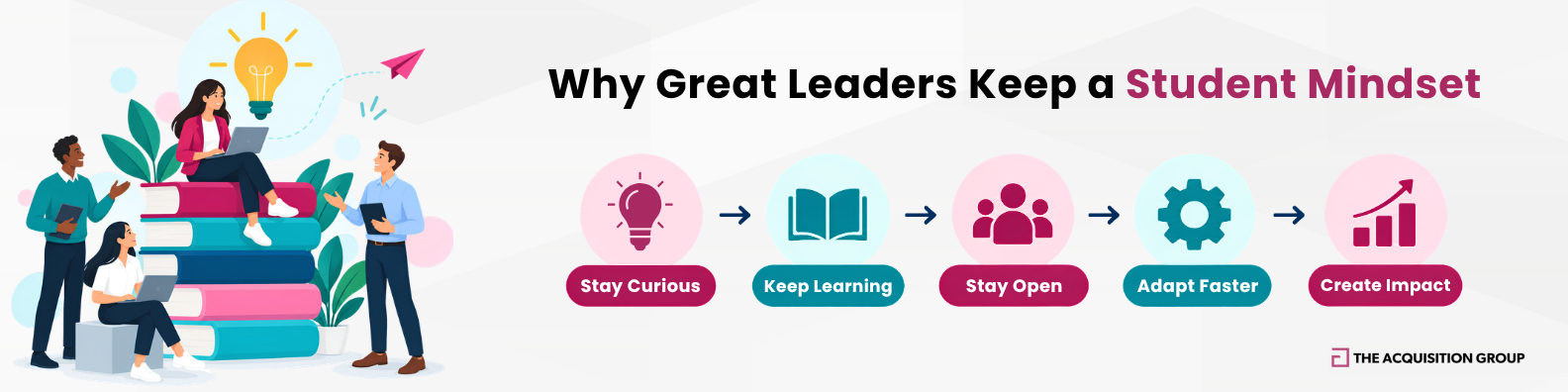
Why Great Leaders Keep a Student Mindset
A student mindset in leadership starts with accepting that you will not always have the best answer in the room. That is because useful ideas are not limited to the person with the most experience.
Every team includes people with different backgrounds and experience. Someone who has worked in customer service may communicate differently than someone in hotel work. Someone new to sales may see a familiar problem in a way that an experienced salesperson has missed.
Being open to those views gives leaders more ways to solve problems. It can reveal something that was overlooked, challenge an assumption, or introduce an approach that may work better. It also reflects a growth mindset in leadership, because it moves the role away from the idea that the most senior person must always have the final word.
Recent research published in a Harvard Business Review article, “Good Leaders Are Good Learners,” found that leaders who were in “learning mode” developed better leadership skills than their peers not in learning mode. The researchers found that leaders in learning mode benefited by adopting a growth mindset (popularized years ago by professor Carol Dweck). Rather than relying on experience alone, these leaders actively looked for opportunities to learn, experiment with different approaches, and reflect on what those experiences could teach them.
This connects closely to a growth mindset in leadership. Staying open to learning gives leaders the opportunity to keep developing their abilities rather than treating their current knowledge or experience as fixed. In practice, that can mean being willing to try a different approach, ask for feedback, or learn from someone whose experience is different from your own.
Sometimes the person who teaches you something new is already on your team. Listening to those ideas also gives team members more opportunities to contribute what they know and play a role in improving how the team works.
Instead of automatically asking, How can I teach my team to do this better? consider asking:
- What can I learn from this situation?
- Is there another way to approach this?
- What does my team see that I might be missing?
- Have I asked for feedback?
- Am I relying on this approach because it is effective, or simply because it is familiar?
- What skills do I need to develop to help my team reach their next level?
These questions make room for reflection without taking away accountability or confidence. You can still make decisions, set expectations, and give direction while staying open to learning. That reflection can help leaders recognize when something needs to change instead of continuing with an approach simply because it has worked before.
Growing With the People You Lead
One of the best examples of leadership development through experience came during a time when teams had to change the way they worked very quickly.
During the COVID-19 pandemic, The Acquisition Group team shifted from face-to-face sales to outbound phone calls. A process built around in-person conversations suddenly had to work in a very different setting. The skills and experience the team already had were still valuable, but the situation required a different way of applying them.
One team member suggested a new approach: instead of trying to do everything in one call, use the first call to gather information, take time to plan, and then return with a second call.
It worked.
“We took what his strategy was. We implemented [it] across the team, and then the whole team started getting results as well.” — Liam Berney, General Manager
Instead of dismissing the idea because it came from someone on the team, they listened to what was working and learned from it. The approach was then shared more widely across the team. One person’s successful approach became something the entire team could benefit from.
That is leadership development through experience in action. It does not always require a course, seminar, or major career lesson. Sometimes, it is simply the willingness to listen when someone has found a better way. Those moments can help leaders improve their own approach while creating an environment where useful ideas can come from anyone.
How Continuous Learning Makes You a Better Leader
The workplace will keep changing. Teams change. Responsibilities shift. The way people communicate and work keeps evolving.
Leaders who keep learning are better prepared to grow with those changes. Instead of having one way of responding to every situation, they have more experience, ideas, and perspectives to draw from when something new comes up.
Continuous learning can help leaders:
- Adapt: What worked before may not work in every new situation. Being willing to adjust can help leaders respond to change instead of forcing an old approach onto a new problem.
- Listen: Different perspectives can reveal things you may have missed. That gives leaders more information to consider before deciding how to move forward.
- Coach: As your team develops, you may need new ways to challenge and support them. Continuing to develop as a leader makes it easier to provide the kind of guidance people need at different stages of their growth.
- Communicate: Working with different people teaches you to adjust how you explain, listen, and give feedback. Clearer communication can strengthen working relationships and make expectations easier to understand.
- Problem-solve: Staying curious makes it easier to consider another approach when the first one is not working. That flexibility can help leaders find solutions that better fit the problem in front of them.
This is where a growth mindset in leadership becomes practical. It is not about constantly chasing the next big lesson. It is about paying attention to what everyday experience is already teaching you. The value comes from taking those lessons and using them to make the next conversation, decision, or challenge better than the last.
Practical techniques and strategies to develop continuous learning in leadership include asking for feedback, reflecting after key conversations, reviewing results with your team, and learning from mistakes without getting stuck on them. These habits help turn everyday experiences into lessons that can actually be applied moving forward.
The goal is not to know everything. It is to stay willing to learn something new. Because as responsibilities grow and situations change, the ability to keep learning gives leaders more ways to respond and help the people around them do the same.

Frequently Asked Questions About Student Mindset
What is continuous learning in leadership?
Continuous learning in leadership means continuing to build your skills, knowledge, and perspective throughout your career. It includes learning from experience, feedback, challenges, mentors, and the people on your team. Doing so helps leaders adapt what they know to new situations instead of relying only on past experience.
Why is continuous learning important for leaders?
It helps leaders adapt, improve, and stay ready for change. It also supports leadership development by building stronger leadership skills over time. As responsibilities and teams change, those skills give leaders more ways to respond to new challenges and support the people around them.
What is a student mindset in leadership?
A student mindset means recognizing that being a leader does not mean having every answer. Leaders with a student mindset stay curious, listen to different perspectives, and look for lessons in everyday experiences. This can help them recognize blind spots, consider new approaches, and continue improving how they lead.
Can leaders learn from their employees?
Yes. Team members bring different backgrounds, ideas, and experience to the workplace. Listening to those perspectives can introduce leaders to new approaches and, in some cases, lead to better ways of working for the whole team. When those ideas are shared, something learned by one person can become something the entire team benefits from.
Continue the Conversation
Interested in hearing more about leadership development, mentorship, and professional growth?
Watch the full conversation on The Acquisition Group’s YouTube channel as our leaders discuss what their teams have taught them and share their perspectives on leadership, growth, trust, mistakes and mentorship.
Looking for your next opportunity? Explore careers at The Acquisition Group and discover an environment where learning, mentorship and professional growth are part of the journey.
